


Industrial Vacuum Cleaner
Industrial Vacuum Cleaner for Heavy-Duty Applications
Industrial environments create cleaning challenges that ordinary vacuum cleaners are not designed to handle. Continuous operating requirements, large quantities of dust and debris, production waste and demanding working conditions require an industrial vacuum cleaner engineered specifically for the job.
Delta Solutions offers industrial vacuum cleaning solutions for factories, manufacturing facilities and other demanding industrial applications across Delhi NCR. The available range includes machines designed for continuous-duty operation, heavy-duty dust and debris collection, light and bulky material recovery, and cleaning around manufacturing areas and production machinery.
The right machine, however, depends on much more than motor power alone. Airflow, vacuum level, filtration, collection capacity, material characteristics and operating duration all influence which industrial vacuum cleaning machine is suitable for a particular facility.
Looking for an industrial vacuum cleaner for your facility? Enquire Now with Delta Solutions to discuss your application and suitable machine options.
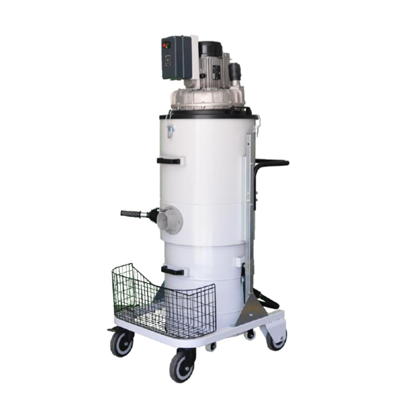
Karcher Industrial Vacuum
(IVR 100/22 Sc)
Technical data:
- Voltage (V) : 415
- Frequency (Hz) : 50
- Electrical Protection (IP) : 55
- Insulation Class (F)
- Rated Power (KW) : 2.2
- Air flow (m3/min) : 300
- Vacuum Max (mm H2O) : 3000
- Noise Level dB(A) : 76
- Container Capacity (l) : 85
- Filter Type : star
- Filter Surface (cm2) : 20000
- Filter Material : polyster
- Filter class (L)
- inlet (mm) : 80
- Weight (kg) 98
- Dimensions (L × W × H) (mm) 82x67x170

Karcher Industrial Vacuum - Textile
(IVR 100/22 Textile)
Technical data:
- Voltage (V) : 415
- Frequency (Hz) : 50
- Electrical Protection (IP) : 55
- Insulation Class (F)
- Rated Power (KW) : 2.2
- Air flow (m3/min) : 300
- Vacuum Max (mm H2O) : 3000
- Noise Level dB(A) : 72
- Container Capacity (l) : 120
- Filter Type : bag
- inlet (mm) : 40
- Weight (kg) 40
- Dimensions (L × W × H) (mm) 60x65x120
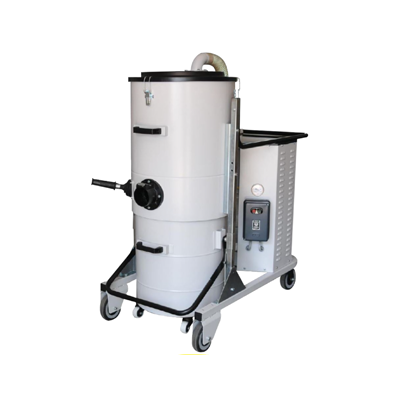
Karcher Industrial Vacuum
(IVM 100/22 Sc)
Technical data:
- Voltage (V) : 415
- Frequency (Hz) : 50
- Electrical Protection (IP) : 55
- Insulation Class (F)
- Rated Power (KW) : 2.2
- Air flow (m3/min) : 300
- Vacuum Max (mm H2O) : 3000
- Noise Level dB(A) : 72
- Container Capacity (l) : 85
- Filter Type : star
- Filter Surface (cm2) : 20000
- Filter Material : polyster
- Filter class (L)
- inlet (mm) : 80
- Weight (kg) 120
- Dimensions (L × W × H) (mm) 118x67x141
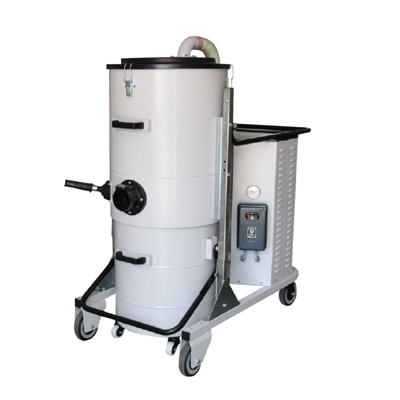
Karcher Industrial Vacuum
(IVM 100/55 Sc)
Technical data:
- Voltage (V) : 415
- Frequency (Hz) : 50
- Electrical Protection (IP) : 55
- Insulation Class (F)
- Rated Power (KW) : 2.2
- Air flow (m3/min) : 300
- Vacuum Max (mm H2O) : 3000
- Noise Level dB(A) : 72
- Container Capacity (l) : 85
- Filter Type : star
- Filter Surface (cm2) : 20000
- Filter Material : polyster
- Filter class (L)
- inlet (mm) : 80
- Weight (kg) 120
- Dimensions (L × W × H) (mm) 118x67x141
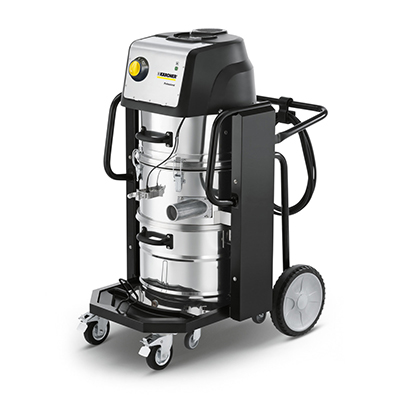
Karcher Industrial Vacuum
(IVC 60/30 Tact 2)
Technical data:
- Air flow (m3/min) : 68 / 244.8
- Vacuum mbar / kPa : 286 / 28.6
- Container Capacity (l) : 60
- Rated input power (KW) : 3
- Filter area (m2) : 1.9
- Current type (Ph / V / Hz) : 3 / 400 / 50
- Nominal size : DN 70
- Accessory nominal size : DN 50 / DN 40
- Sound Level dB(A) : 77
- Weight (kg) 95
- Dimensions (L × W × H) (mm) 970 × 690 × 1240
Industrial Vacuum Cleaner Models Available at Delta Solutions
There is no single industrial vacuum that is ideal for every facility. A textile unit collecting lightweight production waste has very different requirements from an engineering or manufacturing facility dealing with dust and heavier debris.
The industrial vacuum cleaner range available through Delta Solutions therefore covers different performance levels and applications—from specialised textile material collection to continuous and heavy-duty industrial cleaning.
Kärcher IVR 100/22 Sc Industrial Vacuum Cleaner
The IVR 100/22 Sc is designed for continuous and heavy-duty industrial applications. According to its product documentation, it is suitable for industries including automobile, manufacturing, engineering, food, chemical, steel, cement, foundry and ceramic.
A continuous-duty three-phase side-channel vacuum unit provides the vacuum and airflow required for demanding applications. The machine combines a 2.2 kW rated power with 300 m³/h airflow and a maximum vacuum of 3,000 mm H₂O.
Its 85-litre collection capacity helps accommodate substantial quantities of collected material, while the 80 mm inlet allows different hose and accessory sizes to be selected according to the application. A large 20,000 cm² polyester star filter provides substantial filtration surface, and the manual filter-cleaning arrangement allows the operator to clean the filter without dismantling it.
The detachable collection container is another practical advantage where collected material must be emptied regularly. The brochure also identifies a heavy-duty chassis, four large wheels, powder-coated and zinc-plated steel components, and a vacuum gauge for monitoring vacuum level and filter clogging.
Key technical specifications: 415 V, 2.2 kW rated power, 300 m³/h airflow, 3,000 mm H₂O maximum vacuum, 85-litre capacity, 20,000 cm² filter surface, 80 mm inlet and 98 kg machine weight.
Kärcher IVR 100/22 Textile Industrial Vacuum Cleaner
Not every industrial cleaning problem involves conventional floor dust and debris. Textile, paper, packaging and plastic facilities can generate significant quantities of light and bulky material, requiring a different collection approach.
The IVR 100/22 Textile is specifically designed for this requirement. The product documentation identifies paper, textile, packaging and plastic as its primary industrial applications.
The vacuum unit is positioned at the bottom while material enters through the suction inlet at the top. Collected material enters a combined filter and collection bag, where suction helps compact it so that more material can be accommodated within the available space. The bag can then be removed for emptying.
This application-focused design is important for purchase managers and plant teams comparing industrial cleaning equipment. Selecting a vacuum purely by motor rating or tank size can overlook the characteristics of the material that actually needs to be collected.
The IVR 100/22 Textile provides 2.2 kW rated power, 300 m³/h airflow, 3,000 mm H₂O maximum vacuum and a 120-litre collection capacity. Its brochure also highlights a silent, maintenance-free side-channel vacuum unit, easy removal of collected material, a see-through window for material-level indication and a design intended to avoid filter-clogging problems.
Key technical specifications: 415 V, 2.2 kW rated power, 300 m³/h airflow, 3,000 mm H₂O maximum vacuum, 120-litre capacity, bag-type filter, 40 mm inlet and 40 kg machine weight.
How Do Industrial Vacuum Cleaners Handle Demanding Applications?
Industrial vacuum cleaners are designed around more than suction power alone. For demanding applications, factors such as continuous-duty capability, airflow, vacuum performance, filtration, filter cleaning, collection capacity and material handling all influence how effectively a machine can support the cleaning requirement.
The industrial vacuum range available through Delta Solutions uses different configurations for different applications. The IVR and IVM Sc models feature continuous-duty three-phase side-channel vacuum units, while their large star filters and filter-cleaning arrangements support extended industrial operation. The IVC 60/30 Tact² uses a wear-resistant side-channel compressor, Tact² automatic filter cleaning and integrated cyclone pre-separation for its documented manufacturing and production-machinery applications.
Choosing an Industrial Vacuum Cleaner by Application, Not Just Specifications
One of the most common mistakes when evaluating an industrial vacuum cleaner is assuming that the machine with the highest power rating is automatically the best choice.
It isn't that simple.
Industrial vacuum selection starts with understanding what is being collected, where it is generated, how much material accumulates and how long the machine needs to operate.
For example, the IVR 100/22 Sc and IVR 100/22 Textile both have a documented rated power of 2.2 kW and airflow of 300 m³/h. Yet their intended applications and collection arrangements are substantially different. The former uses an 85-litre container and star filter for demanding industrial dust and debris applications, while the Textile model uses a 120-litre bag arrangement specifically designed around light and bulky material.
That is why identifying the best industrial vacuum cleaner in India for a particular business should begin with the operating requirement rather than a specification-sheet comparison alone.
For plant heads, facility managers, EHS teams and purchase managers in Delhi NCR, this application-first approach can make machine evaluation considerably more relevant—especially where the equipment will become part of an ongoing production or housekeeping process rather than being used only for occasional cleaning.
Industrial Vacuum Cleaners Comparison Table
| Model | Rated Power | Airflow | Capacity | Filter | Best Matched Documented Application |
|---|---|---|---|---|---|
| IVR 100/22 Sc | 2.2 kW | 300 m³/h | 85 L | 20,000 cm² star | Continuous/heavy-duty industrial applications |
| IVR 100/22 Textile | 2.2 kW | 300 m³/h | 120 L | Bag | Light and bulky material |
| IVM 100/22 Sc | 2.2 kW | 300 m³/h | 85 L | 20,000 cm² star | Continuous/heavy-duty applications |
| IVM 100/55 Sc | 5.5 kW | 600 m³/h | 85 L | 30,000 cm² star | Higher-airflow heavy-duty requirements |
| IVC 60/30 Tact² | 3 kW | 244.8 m³/h | 60 L | 1.9 m² | Manufacturing areas & production machinery |
Kärcher IVM Industrial Vacuum Cleaners for Continuous and Heavy-Duty Applications
As industrial cleaning requirements become more demanding, buyers need to look beyond container capacity and consider how the vacuum performs during prolonged operation, how filtration is managed and how effectively collected material can be handled.
The Kärcher IVM 100/22 Sc and IVM 100/55 Sc are both positioned for continuous and heavy-duty industrial applications, but their verified technical specifications show an important difference in performance capacity.
Kärcher IVM 100/22 Sc Industrial Vacuum Cleaner
The IVM 100/22 Sc is designed for continuous-duty industrial vacuuming across applications such as automobile, manufacturing, engineering, food, chemical, steel, cement, foundry and ceramic industries. Its product documentation describes a silent, continuous-duty three-phase side-channel vacuum unit intended to provide the vacuum and airflow required for heavy-duty applications.
The machine has a 2.2 kW rated power, 300 m³/h airflow and maximum vacuum of 3,000 mm H₂O. It operates at 415 V and uses an 85-litre detachable collection container.
For facilities dealing with recurring dust and debris collection, filtration deserves particular attention. The IVM 100/22 Sc uses a 20,000 cm² polyester star filter, with L-class filtration specified in the brochure. Its manual filter shaker enables the operator to clean the filter without dismantling it, while dust removed from the filter falls into the collection container.
The brochure also highlights a vacuum gauge for monitoring vacuum level and filter clogging, an 80 mm inlet, detachable collection container, heavy-duty chassis and four large wheels for manoeuvrability.
For purchase managers, these characteristics make the IVM 100/22 Sc more meaningful than simply describing it as a "powerful vacuum." It is a configuration intended around continuous industrial operation, substantial filtration area and practical collection handling.
IVM 100/22 Sc Technical Overview
Specification
IVM 100/22 Sc
Voltage
415 V
Rated power
2.2 kW
Airflow
300 m³/h
Maximum vacuum
3,000 mm H₂O
Container capacity
85 litres
Filter type
Star
Filter surface
20,000 cm²
Filter material
Polyester
Filter class
L
Inlet
80 mm
Noise level
72 dB(A)
Weight
120 kg
Dimensions (L × W × H)
118 × 67 × 141 cm
| Specification | IVM 100/22 Sc |
|---|---|
| Voltage | 415 V |
| Rated power | 2.2 kW |
| Airflow | 300 m³/h |
| Maximum vacuum | 3,000 mm H₂O |
| Container capacity | 85 litres |
| Filter type | Star |
| Filter surface | 20,000 cm² |
| Filter material | Polyester |
| Filter class | L |
| Inlet | 80 mm |
| Noise level | 72 dB(A) |
| Weight | 120 kg |
| Dimensions (L × W × H) | 118 × 67 × 141 cm |
The brochure also lists a 40/50 mm diameter accessory kit comprising a hose, double bend, dry floor tool, crevice nozzle and round brush. Importantly, these accessories are stated to be ordered separately depending on the application, rather than being standard included equipment.
Kärcher IVM 100/55 Sc for More Demanding Heavy-Duty Requirements
The IVM 100/55 Sc takes the continuous-duty industrial vacuum concept into a substantially higher performance configuration.
This distinction is important because the two IVM machines should not be presented as if their specifications are identical.
According to the supplied product PDF, the IVM 100/55 Sc has a 5.5 kW rated power and 600 m³/h airflow, compared with 2.2 kW and 300 m³/h for the IVM 100/22 Sc. Its filter surface also increases to 30,000 cm², compared with 20,000 cm² on the 100/22 Sc.
This gives industrial buyers a clearer reason to evaluate the 100/55 Sc when the application demands greater airflow and a larger filtration surface.
The machine retains an 85-litre detachable collection container, 80 mm inlet and maximum vacuum specification of 3,000 mm H₂O. It also uses a polyester star filter and is specified with L-class filtration.
As with the other continuous-duty models, the product literature highlights a silent and maintenance-free side-channel vacuum unit, detachable container, easy filter-cleaning system and vacuum gauge for vacuum-level and filter-clogging monitoring.
IVM 100/55 Sc Technical Overview
Specification
IVM 100/55 Sc
Voltage
415 V
Rated power
5.5 kW
Airflow
600 m³/h
Maximum vacuum
3,000 mm H₂O
Container capacity
85 litres
Filter type
Star
Filter surface
30,000 cm²
Filter material
Polyester
Filter class
L
Inlet
80 mm
Noise level
74 dB(A)
Weight
150 kg
Dimensions (L × W × H)
118 × 67 × 141 cm
| Specification | IVM 100/55 Sc |
|---|---|
| Voltage | 415 V |
| Rated power | 5.5 kW |
| Airflow | 600 m³/h |
| Maximum vacuum | 3,000 mm H₂O |
| Container capacity | 85 litres |
| Filter type | Star |
| Filter surface | 30,000 cm² |
| Filter material | Polyester |
| Filter class | L |
| Inlet | 80 mm |
| Noise level | 74 dB(A) |
| Weight | 150 kg |
| Dimensions (L × W × H) | 118 × 67 × 141 cm |
The corresponding accessory kit is again identified in the PDF as something that must be ordered separately according to the application.
IVM 100/22 Sc vs IVM 100/55 Sc: What Is the Difference?
This comparison is one of the strongest information-gain opportunities for the category page because the model names alone do not tell a purchase manager which configuration better suits the requirement.
| Specification | IVM 100/22 Sc | IVM 100/55 Sc |
|---|---|---|
| Rated power | 2.2 kW | 5.5 kW |
| Airflow | 300 m³/h | 600 m³/h |
| Maximum vacuum | 3,000 mm H₂O | 3,000 mm H₂O |
| Container | 85 L | 85 L |
| Filter surface | 20,000 cm² | 30,000 cm² |
| Filter type | Star | Star |
| Filter class | L | L |
| Inlet | 80 mm | 80 mm |
| Noise level | 72 dB(A) | 74 dB(A) |
| Weight | 120 kg | 150 kg |
The key takeaway is that larger motor power does not mean a larger collection container or higher maximum vacuum in this comparison.
Both machines have an 85-litre container and a documented maximum vacuum of 3,000 mm H₂O. The major differences are in rated power, airflow, filtration surface and machine weight.
The IVM 100/55 Sc provides twice the documented airflow of the IVM 100/22 Sc—600 m³/h versus 300 m³/h—and 50% more filter surface.
For a plant or purchase team, this is a much more useful way to compare the two than assuming the higher-numbered machine is automatically appropriate.
The actual requirement still needs to determine the selection.
Kärcher IVC 60/30 Tact²: Compact Industrial Vacuum for Production Areas and Machinery
The IVC 60/30 Tact² introduces a different configuration within the range.
Its product documentation describes it specifically as a compact industrial vacuum for cleaning manufacturing areas and production machinery. It is stated to be suitable for continuous use because of its wear-resistant side-channel compressor.
This positioning is particularly relevant for manufacturing facilities where an industrial vacuum cleaner for factory use may need to work around production equipment rather than simply perform general floor cleaning.
The IVC 60/30 Tact² provides a documented 3 kW rated input power, 68 l/s or 244.8 m³/h airflow, maximum vacuum of 286 mbar / 28.6 kPa and a 60-litre container.
Its filter area is specified at 1.9 m².
The machine also uses Kärcher's Tact² automatic filter-cleaning system. According to the supplied brochure, two filters are cleaned using targeted blasts of air, supporting long operating intervals while maintaining suction performance.
Another notable feature is the integrated cyclone for pre-separation, which the product literature states protects the filter and increases its lifetime. The brochure additionally identifies antistatic equipment and liquid cut-off.
These features give the IVC 60/30 Tact² a distinctive place in the range rather than treating it as simply another 60-litre vacuum.
IVC 60/30 Tact² Technical Overview
| Specification | IVC 60/30 Tact² |
|---|---|
| Rated input power | 3 kW |
| Airflow | 68 l/s / 244.8 m³/h |
| Maximum vacuum | 286 mbar / 28.6 kPa |
| Container capacity | 60 L |
| Filter area | 1.9 m² |
| Current type | 3 / 400 / 50 Ph/V/Hz |
| Nominal size | DN 70 |
| Accessory nominal size | DN 50 / DN 40 |
| Sound level | 77 dB(A) |
| Weight | 95 kg |
| Dimensions | 970 × 690 × 1240 mm |
The supplied specification also states "Accessories included: No." That should be communicated accurately rather than automatically presenting accessories from other industrial models as included with this machine.
Understanding Airflow and Vacuum When Choosing an Industrial Vacuum Cleaner
Industrial buyers frequently encounter two performance specifications: airflow and vacuum.
They should not be treated as interchangeable.
At a practical selection level, airflow relates to the volume of air the vacuum moves, while vacuum reflects the pressure differential the machine can generate. The importance of each depends on the material, hose arrangement and actual extraction task.
The verified specifications themselves demonstrate why buyers should avoid judging machines on one number.
For example, the IVM 100/55 Sc provides 600 m³/h airflow and 3,000 mm H₂O maximum vacuum, while the IVM 100/22 Sc provides 300 m³/h airflow with the same documented 3,000 mm H₂O maximum vacuum.
The higher-output machine therefore does not simply have "more of everything." Its performance profile differs in specific ways.
This is why selecting a heavy duty industrial vacuum cleaner should start with the material and application rather than simply comparing kW ratings.
Why Filtration Matters in Industrial Vacuum Cleaning
Filtration becomes particularly important when industrial vacuums are expected to collect dust over extended operating periods.
As material accumulates on a filter, maintaining appropriate filter condition becomes important to the vacuum's operation. The industrial models on this page address that requirement through different systems.
The IVR and IVM Sc machines use large star filters and provide a manual filter-cleaning arrangement. The IVR 100/22 Sc and IVM 100/22 Sc have a documented 20,000 cm² filter surface, while the IVM 100/55 Sc increases this to 30,000 cm².
The IVC 60/30 Tact² takes a different approach with a 1.9 m² filter area and Tact² automatic filter cleaning, complemented by cyclone pre-separation.
The IVR 100/22 Textile differs again because its application revolves around a filter/collection bag designed for light and bulky material.
This variation reinforces an important buying principle:
There is no universally best filtration arrangement for every industrial application.
The material being collected and the operating requirement should determine which configuration is appropriate.
Continuous-Duty Operation: Why It Matters in Industrial Environments
One of the major distinctions between professional housekeeping equipment and purpose-built industrial vacuum systems is the expected operating environment.
Several machines in Delta Solutions' industrial range are explicitly designed around continuous-duty applications.
The supplied documentation for the IVR and IVM Sc models highlights continuous-duty three-phase side-channel vacuum units, while the IVC 60/30 Tact² is specified as suitable for continuous use because of its wear-resistant side-channel compressor.
This matters in manufacturing environments where vacuuming may form part of a recurring production-support or cleaning process rather than an occasional housekeeping task.
A buyer searching for the Best Industrial Vacuum Cleaner in India should therefore ask not only:
"How powerful is it?"
but also:
"Is the machine designed for the duty cycle our operation actually requires?"
For factories and production facilities across Delhi NCR, answering that question early can significantly narrow the appropriate equipment choices.
How to Choose the Best Industrial Vacuum Cleaner in India
Choosing the Best Industrial Vacuum Cleaner in India requires more than comparing motor power, container capacity or machine size. Industrial facilities generate very different materials under very different operating conditions, and those differences should determine the equipment specification.
The product range itself demonstrates this clearly. The IVR 100/22 Textile is designed around light and bulky material in paper, textile, packaging and plastic industries, while the IVR and IVM Sc machines are positioned for continuous and heavy-duty applications across industries such as automobile, manufacturing, engineering, food, chemical, steel, cement, foundry and ceramic. The IVC 60/30 Tact² has yet another focus: manufacturing areas and production machinery.
For plant heads, EHS managers, maintenance teams and purchase managers, a better selection process starts with the application.
1. Identify What the Vacuum Needs to Collect
Start with the material rather than the machine.
Ask what is actually entering the suction hose during normal operation. Is the requirement related to industrial dust and debris, or is the facility generating lightweight and bulky production waste?
This distinction can completely change the appropriate vacuum configuration.
The IVR 100/22 Textile, for example, is specifically designed to collect light and bulky material. Its filter-cum-collection bag allows collected material to be compacted by suction, while its 120-litre capacity provides space for this type of application.
By contrast, the IVR 100/22 Sc, IVM 100/22 Sc and IVM 100/55 Sc use detachable 85-litre collection containers and star-filter arrangements for their documented industrial applications.
The first procurement question should therefore be:
What material are we collecting, and in what quantity?
2. Determine Whether Continuous-Duty Operation Is Required
Industrial vacuuming can range from periodic housekeeping to equipment that needs to operate repeatedly as part of a demanding industrial process.
The supplied product documentation describes the IVR and IVM Sc machines as built for continuous and heavy-duty applications. Their three-phase side-channel vacuum units are specifically highlighted as providing the vacuum and airflow required for these operating conditions.
The IVC 60/30 Tact² is also specified as suitable for continuous use, in this case because of its wear-resistant side-channel compressor.
This distinction matters when comparing an industrial vacuum cleaner for factory use with equipment intended primarily for conventional housekeeping.
If the vacuum forms part of a recurring production or industrial-cleaning process, duty-cycle suitability deserves consideration from the beginning.
3. Compare Airflow According to the Application
Airflow is one of the key specifications available when comparing the machines in this range.
The verified figures are:
| Model | Airflow |
|---|---|
| IVR 100/22 Sc | 300 m³/h |
| IVR 100/22 Textile | 300 m³/h |
| IVM 100/22 Sc | 300 m³/h |
| IVM 100/55 Sc | 600 m³/h |
| IVC 60/30 Tact² | 68 l/s / 244.8 m³/h |
The IVM 100/55 Sc provides the highest documented airflow among these five machines at 600 m³/h.
However, that does not automatically make it the right machine for every facility. The IVR 100/22 Textile demonstrates why: despite having lower airflow, its collection architecture is specifically designed for light and bulky materials.
Performance needs to be interpreted in the context of the material and task.
4. Evaluate Vacuum Performance Alongside Airflow
Vacuum and airflow should be considered together rather than using either specification as an isolated measure of machine quality.
The IVR 100/22 Sc, IVR 100/22 Textile, IVM 100/22 Sc and IVM 100/55 Sc all have a documented maximum vacuum of 3,000 mm H₂O, despite differences in rated power, airflow, filter surface and application.
The IVC 60/30 Tact² is specified differently, at 286 mbar / 28.6 kPa.
This is why purchase teams should avoid reducing industrial vacuum comparison to a single number.
5. Choose the Appropriate Collection Capacity and System
Container capacity influences how much collected material the machine can accommodate, but bigger is not automatically better.
The IVR 100/22 Sc, IVM 100/22 Sc and IVM 100/55 Sc each have an 85-litre collection container. Their documentation describes a detachable drop-down arrangement with castor wheels intended to make collected material easier to remove and dispose of.
The IVR 100/22 Textile increases capacity to 120 litres, but more importantly, its collection method is specifically designed around lightweight and bulky material.
The IVC 60/30 Tact² uses a 60-litre container within its more compact industrial configuration.
A purchase manager should therefore evaluate:
material volume + material characteristics + emptying frequency + collection method
rather than container capacity alone.
6. Pay Close Attention to Filtration and Filter Cleaning
For dust-related industrial applications, filtration is a central part of machine selection.
The IVR 100/22 Sc and IVM 100/22 Sc use 20,000 cm² polyester star filters, while the IVM 100/55 Sc increases filter surface to 30,000 cm². These models are specified with L-class filters in their supplied documentation.
Their manual filter-shaker arrangement allows filter cleaning without dismantling the filter.
The IVC 60/30 Tact² takes a different approach. Its documentation specifies 1.9 m² filter area, Tact² automatic filter cleaning and an integrated cyclone for pre-separation.
The IVR 100/22 Textile again differs because it uses a bag-type filter/collection arrangement for its specialised material-recovery application.
There is therefore no reason to force all five products into the same filtration narrative.
Each solves the problem differently.
7. Check the Available Electrical Supply
Electrical requirements are easy to overlook when researching an industrial vacuum cleaning machine, yet they can immediately determine whether a machine is appropriate for a facility.
The IVR 100/22 Sc, IVR 100/22 Textile, IVM 100/22 Sc and IVM 100/55 Sc are specified at 415 V and 50 Hz.
The IVC 60/30 Tact² is specified as 3 / 400 / 50 Ph/V/Hz.
These are professional industrial configurations. Electrical compatibility should therefore be confirmed as part of site assessment rather than after equipment selection.
8. Consider Inlet Size and Accessory Requirements
Hoses and accessories are not minor afterthoughts in industrial vacuum cleaning.
The IVR 100/22 Sc, IVM 100/22 Sc and IVM 100/55 Sc use an 80 mm inlet. Their product literature specifically notes that this provides the option of using different hose and accessory sizes depending on the application.
The IVR 100/22 Textile uses a 40 mm inlet, while the IVC 60/30 Tact² specifies DN 70 nominal size and DN 50/DN 40 accessory nominal sizes.
Importantly, the PDFs for the IVR/IVM models state that the listed accessory kits are not part of the equipment and need to be ordered separately depending on the application.
That information should be clear during procurement so the machine and required accessories can be specified together.
Industrial Vacuum Cleaners for Different Industries
Industrial vacuum requirements vary considerably between sectors. One of the strengths of Delta Solutions' available range is that the product documentation identifies specific industries and applications rather than treating "industrial cleaning" as a single use case.
Automobile and Engineering Industries
The IVR 100/22 Sc and IVM Sc documentation identifies automobile and engineering among their applications. These environments can require continuous and heavy-duty industrial vacuuming, making operating duty, collection handling and filtration important considerations.
Manufacturing Facilities
Manufacturing is explicitly listed among the applications for the IVR and IVM Sc machines. The IVC 60/30 Tact² is even more specifically positioned for cleaning manufacturing areas and production machinery.
That makes manufacturing one of the most important application clusters for this page.
The correct machine still depends on what the production process generates and where vacuuming needs to take place.
Textile, Paper, Packaging and Plastic Industries
These industries deserve their own treatment because Delta has an application-specific model for them.
The IVR 100/22 Textile is designed to collect light and bulky material in textile, paper and plastic environments, while the brochure also lists packaging among its primary applications.
The filter-cum-collection bag and suction-compaction approach are particularly relevant here because the challenge is not merely collecting conventional floor dust.
Steel, Cement, Foundry and Ceramic Industries
Steel, cement, foundry and ceramic are specifically identified in the documentation for the IVR 100/22 Sc and IVM Sc industrial vacuum machines.
For these applications, the product literature supports positioning the machines around their continuous/heavy-duty construction, filtration arrangements, detachable collection systems and side-channel vacuum units.
We should avoid going beyond the PDFs by claiming suitability for a specific hazardous dust or regulated material unless the relevant machine documentation explicitly supports that application.
Food and Chemical Industries
Food and chemical industries are also listed among the applications for the IVR 100/22 Sc and IVM Sc models.
However, the industry name alone should not be interpreted as meaning every configuration is appropriate for every material or zone within a food or chemical facility.
Specific material characteristics, filtration requirements, site conditions and any applicable safety requirements should be established before selecting equipment.
That qualification strengthens the credibility of the page considerably.
Industrial Vacuum Cleaner vs Wet and Dry Vacuum Cleaner
An Industrial Vacuum Cleaner and a professional wet and dry vacuum cleaner can both appear to solve similar cleaning problems, but they should not automatically be treated as interchangeable equipment.
The industrial machines covered on this page include configurations specifically documented for continuous and heavy-duty applications, industrial material collection, manufacturing areas and production machinery. Several use three-phase side-channel vacuum technology and substantial filtration systems.
A wet and dry vacuum cleaner serves a different professional cleaning requirement, particularly where both liquid and dry material collection are required within its intended application.
The practical question is therefore not:
"Which vacuum is better?"
It is:
"What material needs to be collected, for how long, in what quantity and under what operating conditions?"
For a facility carrying out routine professional housekeeping, a wet and dry vacuum may fit the requirement.
For a manufacturing environment requiring continuous-duty extraction or collection of industrial material, a purpose-built heavy duty industrial vacuum cleaner may be more appropriate.
This distinction should be established before procurement rather than after equipment reaches the facility.
Which Kärcher Industrial Vacuum Cleaner Should You Choose?
Based strictly on the applications and specifications provided in the product documentation, the range can be understood this way:
| Requirement | Model to Evaluate |
|---|---|
| Continuous/heavy-duty industrial dust and debris applications | IVR 100/22 Sc |
| Light and bulky textile, paper, packaging or plastic material | IVR 100/22 Textile |
| Continuous-duty industrial cleaning with 2.2 kW / 300 m³/h configuration | IVM 100/22 Sc |
| Higher-airflow heavy-duty requirements | IVM 100/55 Sc |
| Manufacturing areas and production machinery | IVC 60/30 Tact² |
These are shortlisting directions rather than universal recommendations. Final equipment selection should consider the material, volume, duty cycle, filtration requirement, electrical supply, hose/accessory configuration and operating environment.
That is ultimately what searching for the Best Industrial Vacuum Cleaner in India should lead to: not the machine with the biggest specification, but the machine whose specification best matches the industrial application.
Why Choose Delta Solutions for an Industrial Vacuum Cleaner in Delhi NCR?
Industrial equipment procurement often requires more technical consideration than simply selecting a model from an online catalogue.
Two factories may both require an industrial vacuum cleaner, yet one may need to recover light and bulky production material while another requires continuous-duty collection around manufacturing operations.
Delta Solutions can help industrial buyers across Delhi NCR evaluate the available Kärcher industrial vacuum range according to the actual application.
Instead of beginning with a model number, the discussion should begin with the material being collected, quantity, operating duration, collection location and facility requirements. From there, specifications such as airflow, vacuum, filtration area, container arrangement and inlet/accessory configuration become much more meaningful.
For plant heads, factory owners, facility managers, EHS teams and purchase managers, this application-led approach can reduce the risk of selecting an industrial machine simply because its technical figures look stronger on paper.
Delta Solutions can then help identify which available configuration deserves closer evaluation for the facility.
Need Help Shortlisting an Industrial Vacuum Cleaner?
Share your industry, material to be collected, approximate quantity, operating frequency and application area with Delta Solutions.
This information can help determine which industrial vacuum configuration is most relevant to your requirement.
Choose the Right Industrial Vacuum Cleaner for Your Facility
An Industrial Vacuum Cleaner should solve a specific operational problem.
That may mean collecting dust and debris continuously in a manufacturing facility, recovering light and bulky material in a textile operation, cleaning around production machinery or handling a more demanding application requiring greater airflow.
The five machines available through Delta Solutions demonstrate why there is no meaningful one-size-fits-all answer.
The IVR 100/22 Sc provides a continuous-duty 2.2 kW configuration with an 85-litre collection system. The IVR 100/22 Textile addresses light and bulky material with its 120-litre filter/collection arrangement. The IVM 100/22 Sc provides a 2.2 kW, 300 m³/h configuration, while the IVM 100/55 Sc raises rated power to 5.5 kW and airflow to 600 m³/h. The IVC 60/30 Tact², meanwhile, is specifically positioned for manufacturing areas and production machinery.
For buyers searching for the Best Industrial Vacuum Cleaner in India, the real objective should therefore be to find the best match for the application—not simply the highest specification.
Delta Solutions can help businesses across Delhi NCR evaluate the requirement against material type, collection volume, duty cycle, filtration and operating conditions.
Discuss Your Industrial Vacuum Requirement
Tell Delta Solutions what material you need to collect, where it is generated, how much accumulates and how frequently the vacuum needs to operate.
FAQs
An industrial vacuum cleaner is designed for demanding industrial cleaning and material-collection applications where operating conditions can differ considerably from conventional housekeeping.
Within the range covered on this page, specific machines are documented for continuous and heavy-duty applications, manufacturing areas and production machinery, while the IVR 100/22 Textile is specifically designed to collect light and bulky materials in paper, textile, packaging and plastic industries.
The key difference is the intended operating environment and application.
The industrial machines covered here include features such as continuous-duty three-phase side-channel vacuum units, large filtration surfaces, industrial collection arrangements and heavy-duty chassis designs. The IVC 60/30 Tact², for example, is specifically designed for manufacturing areas and production machinery and is documented as suitable for continuous use.
Equipment should still be selected according to the actual material and operating requirement rather than assuming every industrial vacuum is suitable for every industrial application.
There is no universal Best Industrial Vacuum Cleaner in India because industrial applications differ significantly.
For example, the IVR 100/22 Textile is specifically designed around light and bulky materials, while the IVM 100/55 Sc offers 5.5 kW rated power, 600 m³/h airflow and 30,000 cm² filter surface for more demanding heavy-duty requirements. The IVC 60/30 Tact² has a different proposition again, focusing on manufacturing areas and production machinery.
The best choice is therefore the machine that correctly matches the material, quantity, duty cycle, filtration requirement and working environment.
The IVR 100/22 Textile is specifically designed for collecting light and bulky material in paper, textile and plastic industries, with packaging also listed among its primary applications.
It uses a filter-cum-collection bag in which suction compacts the collected material, helping utilise the available space. Its documented container capacity is 120 litres.
Of the five models covered on this page, the IVM 100/55 Sc has the highest documented airflow at 600 m³/h. It also has a 5.5 kW rated power and 30,000 cm² filter surface.
Higher airflow alone, however, should not determine machine selection.
The IVM 100/22 Sc has 2.2 kW rated power, 300 m³/h airflow and 20,000 cm² filter surface. The IVM 100/55 Sc increases these figures to 5.5 kW, 600 m³/h and 30,000 cm², respectively. Both are documented with an 85-litre container and maximum vacuum of 3,000 mm H₂O.
The 100/55 Sc should therefore be evaluated where the application calls for its higher airflow and larger filtration surface rather than simply because it is the larger model.
Several models covered on this page are specifically documented for continuous-duty or continuous-use applications.
The IVR and IVM Sc machines use continuous-duty three-phase side-channel vacuum units, while the IVC 60/30 Tact² is documented as suitable for continuous use because of its wear-resistant side-channel compressor.
Several models are documented for manufacturing applications. The IVC 60/30 Tact² is particularly noteworthy because its brochure specifically describes it as a compact industrial vacuum for cleaning manufacturing areas and production machinery.
The appropriate machine still depends on what needs to be collected and the operating conditions.
Consider the material being collected, material quantity, operating duration, airflow, vacuum performance, collection capacity, filtration system, filter-cleaning method, electrical supply, inlet size, accessories and mobility.
For an industrial facility, these factors provide a much stronger basis for equipment selection than motor power alone.
Delta Solutions offers Kärcher industrial vacuum cleaner options for professional and industrial requirements across Delhi NCR. Buyers can discuss the industry, material being collected, operating duration and application before shortlisting an appropriate configuration.
