


Single Disc
A professional Single Disc Machine is designed for intensive floor cleaning and maintenance tasks where ordinary mopping or routine cleaning may not deliver the required result. By combining a rotating brush or pad with controlled machine movement, it can support floor scrubbing and other maintenance applications depending on the floor surface, accessory and cleaning procedure being used.
At Delta Solutions, we offer the Kärcher BDS 43/150 C Classic *IN for professional floor cleaning requirements across Delhi NCR. Built with a powerful 1500 W motor, 150 rpm brush speed and robust construction, the machine is designed for diverse floor-cleaning applications in commercial, institutional and appropriate industrial environments.
For facility managers, housekeeping teams and purchase managers, choosing a single disc floor cleaning machine should involve more than comparing motor power. Floor type, cleaning objective, brush or pad selection, machine handling and frequency of use all influence whether the equipment is right for the application.
Looking for a professional Single Disc Machine for your facility? Enquire Now with Delta Solutions.
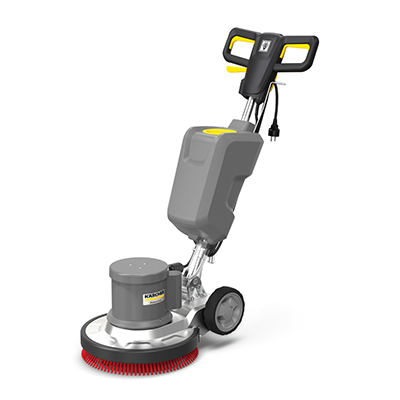
Karcher Single Disc (BDS 43/150 C Classic)
Technical data:
- Working height mm : 90
- Rated input power W : 1500
- Brush speed rpm : 150
- Sound pressure level db(A) : 63
- Frequency (Hz) : 50
- Voltage (V) : 220-240
- Weight (kg) 43
- Dimensions (L × W × H) (mm) 590 × 430 × 1180
Kärcher BDS 43/150 C Classic Single Disc Machine
The *Kärcher BDS 43/150 C Classic IN is a robust single-disc machine developed for diverse professional floor-cleaning applications.
At the heart of the machine is a 1500 W motor combined with a 150 rpm brush speed. Rather than treating these figures as specifications alone, professional buyers should consider what they mean operationally: the machine is configured for controlled mechanical floor cleaning where consistent brush or pad action is required.
The BDS 43/150 C Classic *IN also uses a maintenance-free planetary carrier, an important feature highlighted in the supplied product documentation. For organisations where cleaning equipment is used routinely, robust construction and reduced maintenance requirements can be important considerations alongside cleaning performance.
With a listed machine weight of 43 kg, the unit also has the physical weight needed for professional floor-contact applications while remaining operator-controlled.
The supplied equipment includes a 10-litre tank, scrubbing brush and pad drive board, allowing the machine to support different floor-maintenance requirements when used with the appropriate cleaning accessory and process.
BDS 43/150 C Classic *IN at a Glance
| Specification | BDS 43/150 C Classic *IN |
|---|---|
| Rated input power | 1500 W |
| Brush speed | 150 rpm |
| Working height | 90 mm |
| Sound pressure level | 63 dB(A) |
| Voltage | 220–240 V |
| Frequency | 50 Hz |
| Weight | 43 kg |
| Dimensions (L × W × H) | 590 × 430 × 1180 mm |
| Tank | 10 L |
| Included equipment | Scrubbing brush, pad drive board |
These specifications are most useful when considered alongside the cleaning task. A purchase decision should ultimately reflect the floor surface, required cleaning action and how frequently the machine will operate.
What Is a Single Disc Machine?
A Single Disc Machine is a professional floor-maintenance machine that operates a rotating disc fitted with a suitable brush or pad. The mechanical action generated by the rotating accessory helps perform floor-cleaning and maintenance tasks more effectively than manual methods for appropriate applications.
Unlike equipment designed primarily to vacuum loose dirt, a single-disc machine works directly on the floor surface. Depending on the compatible brush or pad, floor type and cleaning process, it can be used for tasks such as intensive scrubbing and floor maintenance.
The operator guides the machine across the floor while the rotating accessory performs the mechanical cleaning action.
This makes single-disc equipment particularly relevant where facilities require more intensive floor treatment than routine mopping can provide.
However, the accessory matters as much as the machine.
Using an unsuitable brush, pad, chemical or cleaning process for a particular floor can lead to poor results and may risk damaging the surface. The flooring material and required finish should therefore be established before deciding how the machine will be configured.
How Does a Single Disc Floor Cleaning Machine Work?
The principle is relatively straightforward.
The machine's motor drives a single rotating disc positioned against the floor. A suitable brush or pad is attached to this drive system according to the intended cleaning application.
As the disc rotates, it produces consistent mechanical action across the floor surface. The operator controls the machine's movement and guides it systematically over the area requiring treatment.
With the BDS 43/150 C Classic *IN, the 1500 W motor powers the machine at a 150 rpm brush speed.
Its 10-litre tank can support the cleaning process where the applicable procedure requires cleaning solution, while the supplied scrubbing brush and pad drive board provide the foundation for different floor-maintenance configurations.
The result is a machine designed to provide controlled mechanical cleaning rather than relying predominantly on manual scrubbing effort.
For professional facilities, this can help make intensive floor-maintenance work more systematic and repeatable.
What Can a Single Disc Machine Be Used For?
The value of a single-disc machine comes from its ability to support different floor-maintenance applications through the appropriate accessory and cleaning procedure.
Deep and Intensive Floor Scrubbing
Routine mopping is useful for everyday maintenance, but it may not provide enough mechanical action when more intensive cleaning is required.
Key Features of the Kärcher BDS 43/150 C Classic Single Disc Machine
For professional buyers, technical specifications become valuable only when they explain how a machine may fit the actual cleaning requirement.
The *Kärcher BDS 43/150 C Classic IN combines a 1500 W motor, 150 rpm brush speed, 43 kg machine weight and maintenance-free planetary carrier in a robust single-disc platform designed for diverse floor-cleaning applications. The supplied equipment also includes a 10-litre tank, scrubbing brush and pad drive board.
Here is what those characteristics mean from a facility-management and procurement perspective.
Powerful 1500 W Motor for Professional Floor Cleaning
The BDS 43/150 C Classic *IN is equipped with a 1500 W rated input power.
For buyers, however, motor power should be considered alongside brush speed, machine construction, floor-contact accessory and intended application. A powerful motor is useful only when the overall machine is correctly matched to the cleaning task.
The BDS 43/150 C Classic is designed as professional equipment rather than a lightweight domestic floor-cleaning appliance, making it relevant for facilities where mechanical floor cleaning forms part of an organised housekeeping or maintenance programme.
150 RPM Brush Speed for Controlled Cleaning Action
The machine operates at 150 rpm, providing controlled rotational action through the attached brush or pad.
This specification is particularly relevant when evaluating a machine for scrubbing and general floor-maintenance applications. Rather than assuming faster rotation always produces better cleaning, facility managers should match machine speed and accessory selection to the floor surface and desired cleaning result.
For the BDS 43/150 C Classic, its 150 rpm operating speed forms part of a configuration specifically described for diverse floor-cleaning applications.
Robust Construction for Professional Environments
Commercial cleaning equipment is regularly transported, operated and repositioned across working environments. Construction quality therefore matters beyond appearance.
The BDS 43/150 C Classic *IN is described in the supplied documentation as a very robust single-disc machine.
That positioning makes the model relevant for organisations seeking equipment intended for recurring professional floor-maintenance tasks rather than occasional household cleaning.
Maintenance-Free Planetary Carrier
Another notable characteristic is the maintenance-free planetary carrier.
For purchase and facility-management teams, maintainability should be considered alongside cleaning performance. Equipment that forms part of routine operations needs to remain practical to own and manage over time.
The maintenance-free planetary carrier is therefore a meaningful product characteristic for buyers assessing the machine from an operational perspective rather than looking only at its motor specification.
10-Litre Tank for Cleaning Applications
The supplied equipment includes a 10-litre tank.
Where an appropriate floor-cleaning procedure involves the application of cleaning solution, an onboard tank can make the process more practical by allowing the machine and cleaning procedure to work together.
The actual chemical, dilution and cleaning method should always be selected according to the floor material and maintenance requirement.
Scrubbing Brush and Pad Drive Board
The supplied scrubbing brush gives the machine a ready configuration for appropriate scrubbing applications.
The pad drive board adds further flexibility by allowing compatible pads to be used for suitable floor-maintenance processes.
This is an important distinction when assessing a Single Disc Machine: much of its versatility comes from pairing the machine with the correct accessory.
The machine supplies the mechanical action. The brush or pad determines how that action is applied to the floor.
Where Can a Single Disc Machine Be Used?
A professional single disc floor cleaning machine can support floor maintenance across many commercial, institutional and industrial environments. However, suitability should be determined by the floor surface and required cleaning process rather than by the type of building alone.
A hotel and a factory, for example, may both use a single-disc machine, but the flooring, dirt conditions and maintenance objectives can be completely different.
Single Disc Machine for Hotels
Hotels contain numerous areas where floor presentation directly influences the guest experience, including entrances, lobbies, corridors, banquet areas and back-of-house spaces.
Routine mopping can address everyday surface dirt, but scheduled floor maintenance may require stronger mechanical action.
A Single Disc Machine can support intensive scrubbing and appropriate floor-maintenance procedures where the selected brush or pad is compatible with the surface.
For housekeeping managers, this makes accessory selection particularly important. A process intended for a hard-wearing service area should not automatically be transferred to a more sensitive floor finish simply because the same machine is available.
A scrubbing brush provides mechanical action for appropriate cleaning applications, while the pad drive board enables compatible pads to be fitted for suitable maintenance processes.
Selection should consider the floor type, degree of soiling and desired result.
This also creates a useful procurement question for facility managers:
Don't ask only, "Which single disc machine should we buy?" Ask, "Which machine, brush or pad, and cleaning process do we need for this floor?"
That question leads to a much more reliable equipment decision.
Single Disc Machine vs Manual Floor Cleaning
Manual mopping and a single-disc machine perform different roles.
Mopping remains useful for routine cleaning and the removal of everyday surface contamination. It is simple, flexible and practical for frequent housekeeping.
A single-disc machine becomes relevant when the floor requires greater mechanical action than routine manual cleaning provides.
The rotating brush or pad repeatedly works the floor surface while the operator controls the machine. This can make intensive and scheduled floor-maintenance procedures more systematic than relying primarily on manual scrubbing.
That does not mean every daily cleaning task requires mechanical equipment.
A well-designed facility cleaning programme may use manual methods for routine maintenance and bring in a Single Disc Machine when the floor requires a more intensive cleaning process.
Single Disc Machine vs Scrubber Dryer: What Is the Difference?
This is an important distinction for facility and purchase managers because both machines may appear under professional floor-cleaning equipment.
A Single Disc Machine uses a rotating brush or pad to mechanically work the floor. It is particularly useful for appropriate scrubbing and specialised floor-maintenance procedures where operator control and accessory selection are important.
A scrubber dryer is designed around a different workflow: scrubbing the floor and recovering dirty solution as part of the cleaning process. This can make scrubber dryers particularly valuable for productive routine cleaning across larger floor areas.
The practical difference is therefore not simply which machine cleans "better."
A single-disc machine can make sense when intensive floor treatment, controlled mechanical action or accessory-based floor maintenance is the objective. A scrubber dryer may be more suitable when efficient cleaning and recovery across larger areas is the primary requirement.
Many professional facilities can benefit from having both because the machines solve different cleaning problems.
Do You Need a Single Disc Machine or Scrubber Dryer?
Consider a Single Disc Machine when the requirement centres on intensive scrubbing, periodic floor maintenance or other suitable accessory-led floor treatments.
Consider a scrubber dryer when the priority is productive routine cleaning of larger areas with dirty-water recovery integrated into the process.
For a hotel, for example, a single-disc machine may support scheduled maintenance of appropriate floors, while a scrubber dryer can address routine cleaning across larger corridors or common areas.
In a factory or warehouse, the same distinction applies: the correct machine depends on whether the challenge is treating the floor intensively or cleaning large areas productively on a recurring basis.
For buyers who are uncertain, Delta Solutions can evaluate the floor area, surface, cleaning frequency and expected result before recommending the more appropriate equipment category.
When Does the BDS 43/150 C Classic Make Sense?
The *Kärcher BDS 43/150 C Classic IN is worth considering when your facility needs a robust professional machine for suitable floor-cleaning applications and values:
- 1500 W rated input power
- 150 rpm brush speed
- maintenance-free planetary carrier
- 43 kg professional machine construction
- 10-litre tank
- supplied scrubbing brush
- supplied pad drive board
- 63 dB(A) listed sound pressure level
More importantly, it makes sense when these characteristics match the actual floor-maintenance task.
That is the standard Delta Solutions should use when helping businesses across Delhi NCR select professional floor-cleaning equipment: start with the floor and cleaning problem, then determine whether the machine is the right fit.
How to Choose the Best Single Disc Machine in India
Choosing the Best Single Disc Machine in India is not about finding the machine with the highest motor power or the most impressive specification sheet. For professional buyers, the better question is whether the machine is suited to the floor, cleaning objective, operating frequency and people who will use it.
A hotel housekeeping team maintaining guest-facing floors may have very different requirements from a facility team carrying out periodic deep cleaning in a warehouse or factory. Even within the same building, different floors may require different brushes, pads and cleaning procedures.
For facility managers and purchase managers, the following factors should therefore be evaluated before investing in a Single Disc Machine.
Start with the Floor and Cleaning Objective
The first question should not be:
"How powerful is the machine?"
It should be:
"What exactly are we trying to achieve on this floor?"
Routine cleaning, intensive scrubbing and specialised floor-maintenance procedures are different tasks. The appropriate brush or pad, cleaning chemical and operating method can change accordingly.
Before selecting a machine, identify the floor surface, its present condition, the type of contamination and the result expected after cleaning.
This is especially important because a powerful professional machine used with an unsuitable accessory or cleaning process may not deliver the desired outcome.
The BDS 43/150 C Classic *IN is described as suitable for diverse floor-cleaning applications, but that should not be interpreted as permission to use the same configuration on every surface.
Consider Motor Performance in Context
The Kärcher BDS 43/150 C Classic *IN has a 1500 W rated input power.
That gives buyers a useful indication of the machine's professional configuration, but wattage alone does not determine whether a single-disc machine is suitable for an application.
Motor performance should be evaluated together with brush speed, machine weight, accessory selection and cleaning objective.
This is a recurring principle when purchasing professional cleaning equipment: specifications should be interpreted as a system rather than ranked individually.
Evaluate the Brush Speed
The BDS 43/150 C Classic *IN operates at 150 rpm.
RPM matters because the rotating brush or pad provides the mechanical action used during floor treatment. Different cleaning and maintenance processes can require different operating characteristics.
For this reason, comparing two machines purely by deciding that the higher-rpm option must be superior can lead to the wrong purchase decision.
For buyers considering this Kärcher model, its 150 rpm speed should be assessed against the specific scrubbing or maintenance task the facility intends to perform.
Consider Machine Weight and Operator Handling
The BDS 43/150 C Classic *IN weighs 43 kg.
Machine weight contributes to its professional construction and floor-contact operation, but single-disc equipment is manually guided. Operator handling therefore deserves serious consideration.
A machine may have excellent technical specifications, but productivity can still suffer if operators are not comfortable using it correctly.
Training and familiarisation are particularly important for teams transitioning from manual floor cleaning to a single-disc machine for the first time.
Purchase managers should therefore think beyond the equipment itself and consider who will operate it, how frequently it will be used and whether the cleaning team understands appropriate machine control.
Check the Brush and Pad Requirements
The BDS 43/150 C Classic *IN is supplied with a scrubbing brush and pad drive board.
These accessories are important because a single-disc machine derives much of its versatility from the cleaning tool fitted underneath it.
The appropriate brush or pad should be selected according to the floor and required treatment. A configuration intended for more intensive scrubbing may not be appropriate where the floor requires a gentler maintenance process.
Before purchasing, clarify both:
Which machine do we need?
and
Which accessories will we require for our floors?
Buying the machine without considering the second question can limit its usefulness from the beginning.
Consider Cleaning Solution Requirements
The supplied configuration includes a 10-litre tank.
For procedures requiring cleaning solution, an onboard tank can support a more organised cleaning process. However, chemical selection and dilution should still follow the requirements of the flooring, contamination and applicable cleaning procedure.
Using more chemical or a stronger formulation does not automatically produce a better result.
The machine, accessory, chemical and method need to work together.
Think About Frequency of Use
How often will the Single Disc Machine actually operate?
A hotel may incorporate it into scheduled floor-maintenance routines. A commercial facility may use it periodically for deeper cleaning, while an industrial site may have different requirements depending on floor contamination.
Understanding usage frequency helps determine whether the machine fits the facility's operational plan.
It also helps buyers decide whether a single-disc machine alone is sufficient or whether it should work alongside other equipment such as dry vacuum cleaners, wet and dry vacuum cleaners, sweepers or scrubber dryers.
Best Single Disc Machine in India: What Should “Best” Actually Mean?
Searches for the Best Single Disc Machine in India naturally suggest that buyers want a straightforward winner.
Professional floor cleaning rarely works that way.
The best machine for a particular facility is one that delivers the required mechanical cleaning action while remaining suitable for the floor, workload, operators and maintenance programme.
A more useful evaluation should therefore consider:
- the floor type and condition;
- required cleaning or maintenance process;
- motor performance and brush speed;
- compatible brushes and pads;
- machine construction and handling;
- frequency and duration of operation;
- availability of product guidance and support.
The Kärcher BDS 43/150 C Classic *IN combines a 1500 W motor, 150 rpm brush speed, 43 kg machine weight, 10-litre tank, maintenance-free planetary carrier, scrubbing brush and pad drive board.
Whether that makes it the right machine depends on how closely those characteristics align with the facility's requirements.
This is a much stronger purchasing criterion than simply labelling a product "best."
Who Should Consider the Kärcher BDS 43/150 C Classic?
The BDS 43/150 C Classic *IN can be considered by professional organisations requiring controlled mechanical floor cleaning for suitable surfaces and applications.
That can include housekeeping and facility-management teams responsible for hotels, healthcare facilities, commercial buildings, educational institutions, retail premises, warehouses and appropriate industrial environments.
For a purchase manager, there are several signs that a single disc floor cleaning machine may deserve consideration.
If manual scrubbing is becoming inefficient for periodic intensive cleaning, if floors require more mechanical action than routine mopping provides, or if the facility needs a machine capable of working with different compatible floor-maintenance accessories, a single-disc machine may fill that gap.
On the other hand, if the main challenge is rapidly washing and recovering dirty solution from very large floor areas every day, a scrubber dryer may deserve greater consideration.
Equipment selection should follow the cleaning process rather than forcing one machine to perform every job.
Equipment selection should follow the cleaning process rather than forcing one machine to perform every job.
When a Single Disc Machine May Not Be the Right Choice
Authoritative product content should also explain when not to buy the product.
A Single Disc Machine may not be the most efficient primary solution when the facility mainly needs routine cleaning across very large open floor areas with simultaneous dirty-water recovery.
In that situation, a walk-behind scrubber dryer or ride-on scrubber dryer may provide a more productive cleaning workflow.
Similarly, a single-disc machine is not a substitute for a sweeper when the main problem is collecting substantial quantities of loose dry debris. Nor does it replace a vacuum cleaner where the cleaning objective is dust and debris extraction.
Large facilities often achieve better results by building a cleaning-equipment system in which different machines perform the jobs they are specifically designed to handle.
This is particularly relevant for factories, warehouses, hospitals, hotels and large commercial properties.
Single Disc Machine vs Scrubber Dryer: Which Should You Choose?
Although both machines can scrub floors, their operating processes are different.
A Single Disc Machine mechanically works the floor through a rotating brush or pad. It provides operator-controlled action and can support intensive scrubbing and suitable maintenance procedures depending on the accessory being used.
A scrubber dryer is designed to combine floor scrubbing with dirty-solution recovery, making it particularly useful for productive routine cleaning.
| Requirement | Single Disc Machine | Scrubber Dryer |
|---|---|---|
| Intensive mechanical scrubbing | Strong fit | Suitable depending on application |
| Accessory-led floor maintenance | Strong fit | More limited/specific |
| Dirty-water recovery in the same cleaning process | No integrated recovery stated for BDS 43/150 C Classic | Core function |
| Large-area routine floor cleaning | Can be used, but labour intensive | Generally more productive |
| Operator-controlled floor treatment | Strong fit | Different operating workflow |
| Periodic deep cleaning | Strong fit | Suitable depending on requirement |
Neither category is universally better.
If the facility needs controlled mechanical floor treatment, a single-disc machine can be the more appropriate tool. If the priority is efficient recurring cleaning with solution recovery, a scrubber dryer may offer greater operational productivity.
Some facilities need both.
Single Disc Machine vs Floor Polisher: Are They the Same?
The terms are sometimes used interchangeably in searches, but buyers should be careful about treating every single-disc machine as identical to every floor-polishing machine.
A single-disc platform can support different floor-maintenance processes depending on its speed, compatible accessories and intended application. Scrubbing and polishing are not automatically the same procedure simply because both involve a rotating disc.
The BDS 43/150 C Classic *IN supplied information confirms a 150 rpm brush speed, scrubbing brush and pad drive board. Any polishing or specialist maintenance process should therefore be considered in relation to compatible accessories, floor requirements and the manufacturer's intended use.
For SEO, this distinction is valuable because it answers the user's question without making unsupported product claims.
Single Disc Machine vs Manual Scrubbing: When Does Mechanisation Make Sense?
Manual scrubbing can remain practical for small, inaccessible or highly localised areas.
The limitation becomes more apparent when teams repeatedly perform intensive cleaning across larger suitable floor sections.
A Single Disc Machine introduces consistent motor-driven mechanical action through the brush or pad. Instead of relying predominantly on manual scrubbing effort, operators guide the equipment while the rotating accessory works the floor.
For facility managers, the benefit is not simply that the machine is "faster." The more important advantage is the ability to create a more systematic mechanical cleaning process where the application justifies it.
Manual methods will still have a place around edges, confined spaces and routine housekeeping. Mechanised and manual cleaning should complement one another rather than being treated as mutually exclusive.
Questions Purchase Managers Should Ask Before Buying
Before requesting a quotation for a Single Disc Machine, establish the actual operating requirement internally. A useful procurement discussion should answer:
- What floor surfaces will the machine be used on?
- What cleaning problem are we trying to solve?
- Is the requirement routine cleaning, deep scrubbing or periodic floor maintenance?
- Which brushes or pads are appropriate for those floors?
- How large is the cleaning area?
- How frequently will the machine operate?
- Who will operate the equipment?
- Would a single-disc machine or scrubber dryer better suit the cleaning workflow?
- What product guidance, accessories and support will be available after purchase?
Providing these details when contacting Delta Solutions can make the recommendation substantially more application-specific.
Why Choose Delta Solutions for a Single Disc Machine in Delhi NCR?
Buying professional floor-cleaning equipment involves more than identifying a model online.
A facility may know that it needs better floor cleaning but still be uncertain whether the appropriate solution is a single-disc machine, scrubber dryer or another type of industrial cleaning equipment.
Delta Solutions supports professional cleaning requirements across Delhi NCR, allowing facility managers, housekeeping teams and purchase managers to approach equipment selection around the actual application.
For the Kärcher BDS 43/150 C Classic *IN, that means considering the flooring, cleaning objective, operating frequency and accessory requirements before deciding whether its 1500 W motor, 150 rpm operating speed and single-disc configuration are suitable.
This application-led approach is particularly important for organisations where cleaning equipment will become part of an ongoing facility-maintenance programme rather than an occasional purchase.
If the BDS 43/150 C Classic fits the requirement, buyers get a robust professional machine with a maintenance-free planetary carrier and the supplied equipment needed to support suitable floor-cleaning applications.
If another equipment category would better solve the problem, that should be identified before the investment is made.
Need Help Selecting the Right Floor Cleaning Machine?
Tell Delta Solutions about your floor type, cleaning area, existing cleaning method and the result you want to achieve. The team can help determine whether a Single Disc Machine is appropriate for your facility in Delhi NCR.
Choose the Right Single Disc Machine for Your Floor Cleaning Requirement
A professional Single Disc Machine can significantly strengthen a facility's floor-maintenance programme when the equipment is selected and used for the right application.
The Kärcher BDS 43/150 C Classic *IN combines a 1500 W motor, 150 rpm brush speed, 43 kg machine weight and maintenance-free planetary carrier in a robust configuration developed for diverse floor-cleaning applications. Its supplied 10-litre tank, scrubbing brush and pad drive board further support suitable professional floor-maintenance processes.
However, specifications alone should never determine the purchase.
The flooring, type of contamination, required cleaning result, brush or pad, frequency of operation and operator requirements should all be considered. A Single Disc Machine can be highly effective for suitable intensive cleaning and maintenance applications, while a scrubber dryer or another type of cleaning equipment may make more operational sense for a different requirement.
This is also the right way to approach a search for the Best Single Disc Machine in India. Instead of looking for a universal "best" machine, look for the equipment configuration that best matches the work your facility needs to perform.
For businesses across Delhi NCR, Delta Solutions can help assess the application and determine whether the BDS 43/150 C Classic *IN is the appropriate choice.
Need a Single Disc Machine for Your Facility?
Share your floor type, approximate cleaning area, cleaning challenge and frequency of use with Delta Solutions. This will help identify whether the BDS 43/150 C Classic *IN fits your floor-maintenance requirement.
FAQs
A Single Disc Machine is used for professional floor cleaning and maintenance where controlled mechanical action from a rotating brush or pad is required. Depending on the floor surface, compatible accessory and cleaning procedure, it can support intensive scrubbing and other suitable floor-maintenance applications.
The machine should always be configured according to the flooring and intended result rather than using the same brush or pad for every surface.The Kärcher BDS 43/150 C Classic *IN has a specified brush speed of 150 rpm. It is powered by a 1500 W motor and is designed for diverse professional floor-cleaning applications.
RPM should not be evaluated independently. Floor type, machine weight, brush or pad selection and the required cleaning process also influence whether the machine is suitable for a particular application.
Yes. The supplied product information describes the BDS 43/150 C Classic *IN as a robust single-disc machine for diverse floor-cleaning applications. It features a 1500 W motor, 150 rpm brush speed and maintenance-free planetary carrier.
Its supplied equipment includes a 10-litre tank, scrubbing brush and pad drive board.
A single-disc machine can support intensive or deep floor cleaning when equipped with an appropriate brush or pad and used with a suitable cleaning process.
The exact configuration should depend on the floor material, degree of soiling and desired result. More aggressive mechanical cleaning is not automatically suitable for every floor.
Single-disc machines can support certain floor-maintenance and polishing applications when their operating characteristics, compatible accessories and the floor itself are suitable.
For the BDS 43/150 C Classic *IN, the supplied information confirms a pad drive board and scrubbing brush. Specific polishing applications should therefore be carried out only with a compatible pad/accessory and appropriate floor-maintenance procedure.
A Single Disc Machine uses a rotating brush or pad to mechanically work the floor and is particularly useful for appropriate intensive scrubbing and floor-maintenance procedures.
A scrubber dryer is designed to scrub the floor while recovering dirty solution as part of the cleaning process. This makes scrubber dryers particularly useful for productive recurring cleaning across larger areas.
The right choice depends on whether the priority is controlled floor treatment or routine cleaning with integrated dirty-water recovery.
For suitable larger areas and intensive cleaning requirements, a Single Disc Machine provides consistent motor-driven mechanical action that can make the cleaning process more systematic than relying primarily on manual scrubbing.
Manual cleaning still remains useful for routine housekeeping, edges, confined areas and localised cleaning. Professional facilities can use both methods as part of the same cleaning programme.
It can be suitable for appropriate floor-cleaning applications in factories and warehouses. The decision should depend on the floor surface, type of contamination, area being cleaned and desired cleaning result.
Where the primary requirement is recurring cleaning of very large floor areas with simultaneous dirty-water recovery, a walk-behind or ride-on scrubber dryer may be more productive.
When evaluating the Best Single Disc Machine in India, consider the floor type, cleaning objective, motor performance, brush speed, machine weight, compatible brushes and pads, frequency of operation, operator handling and after-sales support.
The best machine should be the one correctly matched to your application rather than simply the model with the highest wattage or rpm.
Delta Solutions offers the Kärcher BDS 43/150 C Classic *IN for professional floor-cleaning requirements across Delhi NCR. Facility managers, housekeeping teams and purchase managers can discuss their floor type, cleaning area and application before selecting the equipment.
